
Code Repository
What's inside
PeriodicWave: Neural Network Variational Monte Carlo for Solids
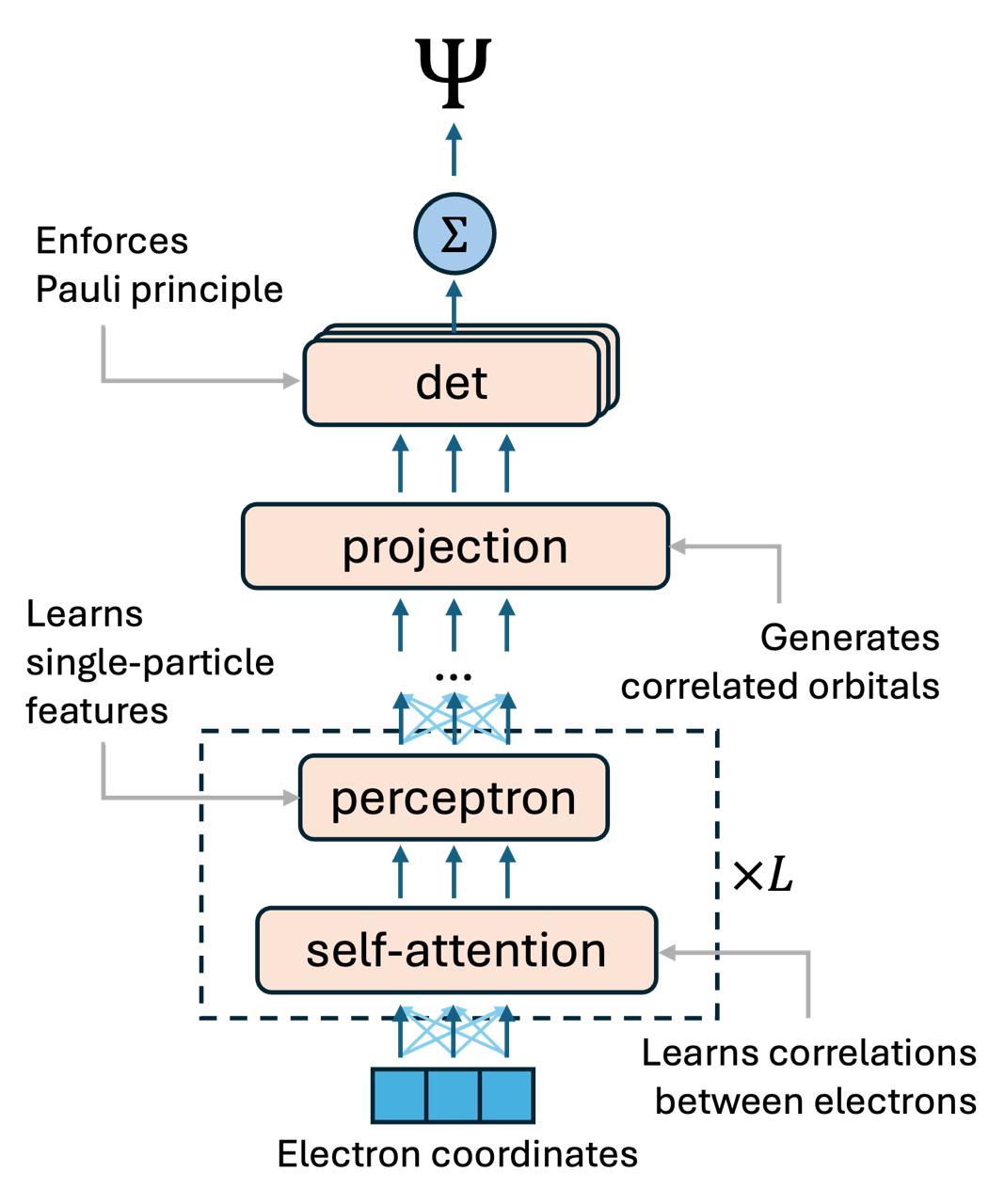
This repository contains a Monte-Carlo solver to train neural-network variational wavefunction to solve continuous-space Fermi systems, which was developed out of the work [M Geier, K Nazaryan, T Zaklama, L Fu, Phys. Rev. B 112, 045119 (2025)].
We provide an optimized self-attention neural network wavefunction ansatz to capture electron correlations. Additionally, we introduce a new neural network architecture -- SlaterNet -- that implements an unrestricted Hartree-Fock solver.
Our AI-based method successfully solves the problem of moire semiconductors in two-dimensional materials. It outperforms traditional exact-diagonalization methods based on a projection to a finite number of orbitals. Thus, our approach advances the state-of-the-art in simulating quantum many-body systems from first principles.
We provide an optimized self-attention neural network wavefunction ansatz to capture electron correlations. Additionally, we introduce a new neural network architecture -- SlaterNet -- that implements an unrestricted Hartree-Fock solver.
Our AI-based method successfully solves the problem of moire semiconductors in two-dimensional materials. It outperforms traditional exact-diagonalization methods based on a projection to a finite number of orbitals. Thus, our approach advances the state-of-the-art in simulating quantum many-body systems from first principles.
Q-stage: Foundation Model for Quantum States
This repository contains an attention-based foundation model for quantum many-body systems, developed as part of the work “Attention-Based Foundation Model for Quantum States.” (arXiv:submission.7075500)
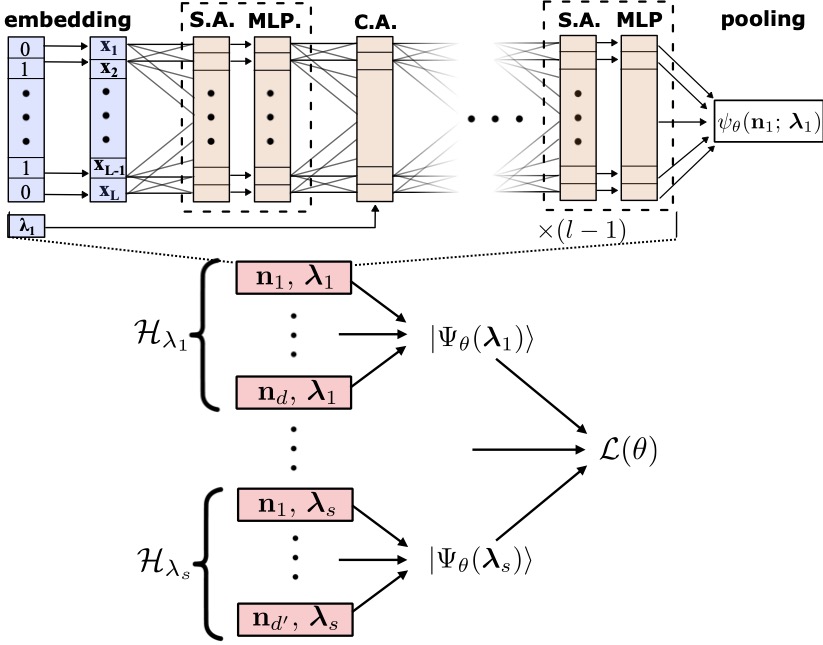
Q-stage is a transformer-inspired neural quantum state that takes both the configuration and the Hamiltonian as inputs, enabling one model to generalize across system sizes, coupling strengths, and phases. Its architecture captures quantum correlations with minimal inductive bias and learns a continuous mapping from Hamiltonian parameters to wavefunctions.
The method accurately reproduces exact-diagonalization ground states on a range of benchmark models and shows strong generalization to Hamiltonians not included in training. Q-stage is a general foundation model framework built towards an universal quantum wavefunction predictor across all of quantum physics.
Q-stage is a transformer-inspired neural quantum state that takes both the configuration and the Hamiltonian as inputs, enabling one model to generalize across system sizes, coupling strengths, and phases. Its architecture captures quantum correlations with minimal inductive bias and learns a continuous mapping from Hamiltonian parameters to wavefunctions.
The method accurately reproduces exact-diagonalization ground states on a range of benchmark models and shows strong generalization to Hamiltonians not included in training. Q-stage is a general foundation model framework built towards an universal quantum wavefunction predictor across all of quantum physics.
Our code is open source and freely available to the community.